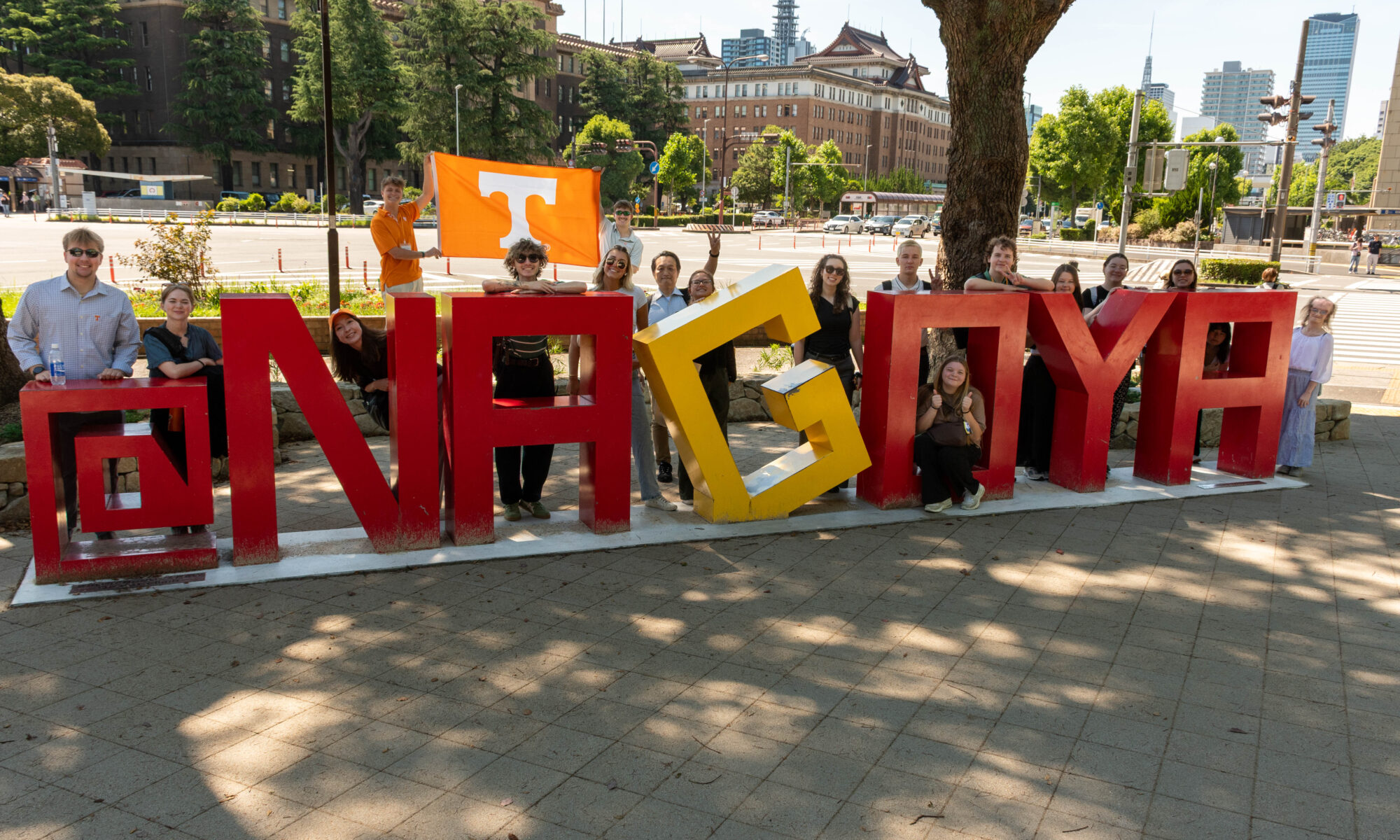
This Step Outside episode takes place on the other side of the world in Japan.
The One Health in Agriculture and Natural Resources study abroad program started in Tokyo and went to Kyoto and Nagoya. The group visited Tokyo University of Agriculture, also known as NODAI, and Nagoya University.
Dr. Shigetoshi Eda, School of Natural Resources professor and scholar-in-chief of the UT One Health Initiative, led the program.
“The main purpose of this course is for students to think about how they can apply a One Health approach to different kinds of issues in agriculture and natural resources and good safety,” Eda says, “But also I want students to enjoy Japanese culture. In the evening after the program ends, students have the opportunity to go out and go to different places and experience pop culture and enjoy food.”
In Tokyo, students learned about the cultural and economic importance of rice in Japan. On the second day, Typhoon Jangmi moved through, forcing the university to cancel in-person activities, but as professor Nina Shimoguchi said, the typhoon moved through like a bullet train, and the weather cleared up for the students’ hands-on rice planting lesson.
They donned boots and squelched through rice paddy fields at the university’s Isehara Farm. Afterward, students attended a lecture and a student exchange at the Atsugi campus. Study abroad coordinator Kyra Barrier says meeting peers in Japan helped immerse students in Japanese culture.
“Our students really enjoyed the time they got to spend with their peers in Tokyo Noda University because they got to talk to other Japanese students and really talk about, like, what brought them to Japan and the pop culture and just really connect with other Japanese students,” Barrier says.
“You get to meet Japanese students and interact with them and different professors who have very like niche degrees, which is pretty amazing,” Abigail Scott, senior in plants sciences, says.
Before leaving Tokyo, the group took a biodiversity tour on Mt. Takao in Meiji no Mori Takao Quasi-National Park. They took a cable car partway up the mountain, visited a Monkey Park, and then hiked past shrines, statues, and the main temple, Takaosan Yakuōin Yūkiji. They even saw monks before reaching the top.
The next day they took the Shinkansen, or bullet train, to Kyoto.
“Seeing all the different landscapes that Japan has on the bullet train was one of my favorite parts because we drove through multiple different cities and got to see different landscapes we haven’t seen before, so like coastal areas and mountains,” Scott says. “That was been that’s been my favorite part.”
“What’s really great about this one is you get to see the rural beauty of Japan, the mountains, the fields and the forests,” Michelle Hung, doctoral student and graduate assistant in the Smith Center for Sustainable Agriculture, says. She co-led the program with Dr. Eda.
Their journey continued with a visit to the Arashiyama Bamboo Forest. They then took the Sagano Scenic Railway back to Kyoto. The next day they toured the Nijo Castle and the Kiyomizu-dera Temple in Kyoto. They later boarded the Shinkansen again to travel to Nagoya.
After meeting with Nagoya University faculty members, the group went to the university’s TOGO Field Research Lab.
“They kindly let us see their research facilities that house animals at a farm, and that was a lot of fun,” Hung says.
“We got to see baby goats, and then I also got to do an abdominal ultrasound. It was through the colon but is for uterine like AIs,” Landon Smith, senior in animal science, says.
The next day they toured the Aoi Seicha Tea Farm in Nishio. They dressed in traditional tea leaf-picking attire and went into the fields.
“We’re making matcha in Nishio. We’re very excited to try this. It looks delicious. She just gave us a tutorial,” Sawyer Stephens, senior in food and agriculture business, said during the lesson. The group learned how they make matcha and how to drink it during a matcha tea ceremony.
“I thought that was really cool just to see how much is made because I love matcha, so that was really fun,” Emery Nelson, senior in environmental and soil sciences, says.
On their final day in Nagoya, the group visited Nagoya Castle and the popular Osu Shopping District. They then gave presentations at Nagoya University and enjoyed a farewell dinner before heading back to Tokyo.
As Dr. Eda mentioned, the students also used their free time to explore every day. They enjoyed different foods, museums, and cultural sites in each city. They even paid a visit to the Good Ole Tennessee Bar in Tokyo.
“Go out of your room. Go try the different foods, even if you don’t like it. Go see the different buildings in your free time because a lot of the great things you’ll see are not with the class,” Smith says.
They encourage other students to explore in future study abroad programs.
“Definitely do it. It’s been so fun and just such a great opportunity,” Nelson says.