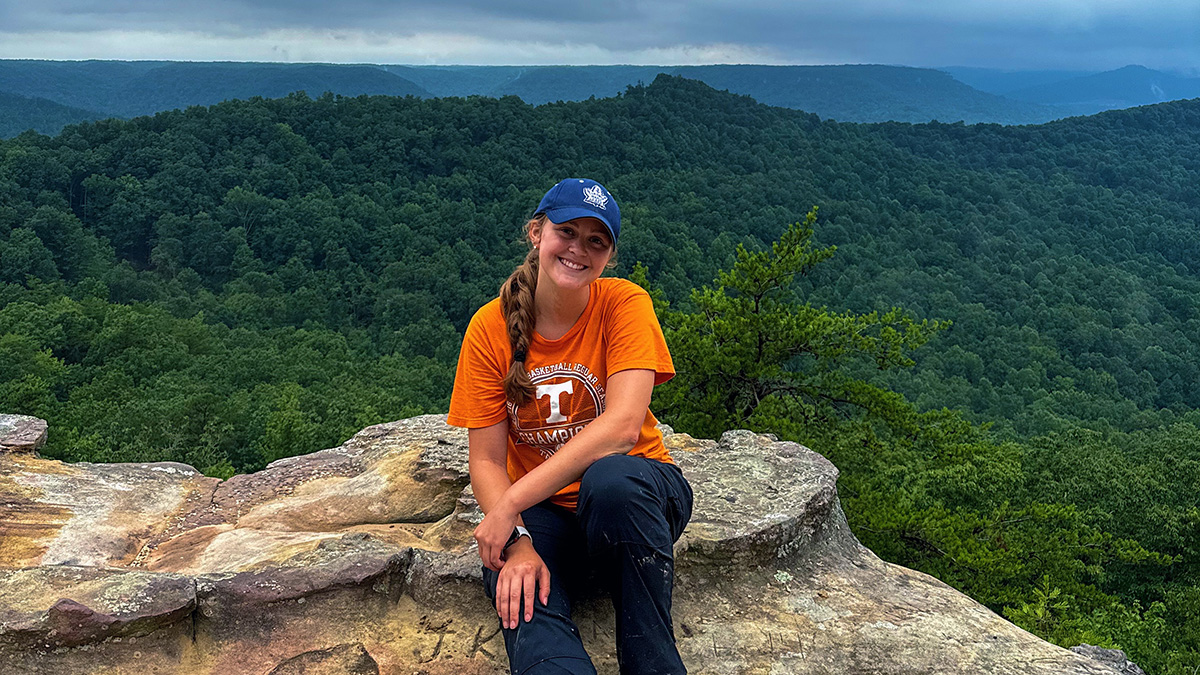
Master’s student and graduate research assistant Madison Janes collected data on off-highway vehicles (OHV) in Pickett State Park, Natchez Trace State Park, and Franklin State Forest for a project led by Professor Ryan Sharp in partnership with the Tennessee Division of Forestry. She and other graduate students also used an online form to survey OHV users. For episode 38 of the Step Outside series, she shares the findings, potential solutions, and how people can learn about the research. You can watch the full interview below or on our YouTube channel.
The transcript below has been lightly edited.
Hi, everyone. Welcome to the Step Outside series. Today, joining me is Madison Janes. She is a graduate student in forestry, concentrating in outdoor recreation and park management. Thank you so much for being here today.
Thank you for having me. I’m so excited.
Yes, and I wanted to have you on to talk about your research, which you’ve been looking at off-highway vehicles and their impacts to state forests, mostly state forests. Could you talk a little bit about that?
So for my thesis, we looked at off-highway vehicles and their effects on trails. We call it trail degradation, which is how they affect trails, and we showed users of these trails photos. We had them tell us how acceptable trail degradation is through a series of four photos. It’s a two-part project that we did with the Division of Forestry. So we went out in the summer of 2024, and we took a bunch of trail recreation ecology measurements. So we looked at how the trail was widening, how vegetation was affected, what kind of ruts there were, and how the trail was shaping. When trails are used a ton, they start to shape almost like a ‘U’. They start to go in, and so we measured that. Then, we gave a survey to off-highway vehicle users online. We did ask them a bunch of questions, demographics like what year they were born. What county do they live in? We asked if they were from Tennessee or not, which was really interesting because we had half of the people were from Tennessee and half were out of state. We asked management questions, and then we asked the question of how acceptable are these conditions for OHV use? We showed those photos, and that’s what my thesis focused on. Then we did a second part, which we’re currently doing, where we asked about non-OHV users and what are their thoughts on off-highway vehicle use.
As far as what you focused on for your thesis, what was acceptable for those users? What did they say?
So what we found was surprising. We found that people found every condition that we had shown. So that first photo is that very minimally eroded, and then that fourth one is very severely eroded. We found that every condition that was shown on average was acceptable. It was ranked like, if we think of it as like an axis, an axes. The minimally eroded photo was rated as acceptable, and then as we went through the photos one through four, it was rated acceptable. It was still above zero, but it was starting to go down the curve. So I think that average rating was like out of one. So people were starting to disagree about what was most acceptable. I guess that’s what I’m trying to say. For photo one, more people agreed, and then by photo four, there was much more disagreement about how acceptable it was. So that was surprising because prior research had shown at that more severe photo, we should see people rating that as unacceptable in different hiking studies and mountain biking studies and crowding studies, but we didn’t see that. So that was surprising.
That is interesting, and you did this in partnership with the Division of Forestry. How are they hoping to use this information?
They’re hoping to use it as just a baseline. Basically, they didn’t have any type of, for example, permitting system or fees. They weren’t even sure how many people were using it, or what time they were using it. That first part we did where we did those measurements in the field, we also put up counters to give them an idea of how many people were using it, how often they were using it. Also, we asked the management actions. So, they want to know how people feel about certain things before they do certain things to make good decisions for everyone. Everyone needs to be involved, like the people who use the resource and the people who manage the resource. So they also got an idea of how people felt about, for example, whether they would want fees. Would they want to close the trails? Just questions like that.
Was there a big positive feedback as far as closing the trails or fees or anything like that?
People, I do believe off the top of my head, said that they would pay a fee if that were to go to like maintenance. People weren’t as supportive as to closing because that takes away the resource, which is understandable. You want to ask these different types of access questions to see what people say, but I think people were most in agreement that they would pay a fee if that went towards maintenance of the trail and education, signage, stuff like that.
About how many people did your surveys?
So we were going to do it in the field, and when we were out collecting that trail erosion data, we weren’t seeing many users. So we were like, we’re going to have to pivot. So we decided to do online surveys. We decided that through some of the Division of Forestry contacts and some very active Facebook groups we would send out the link and have them take it that way. It wasn’t our first choice, and there’s definitely some limitations with getting data like that, but we ended up getting about 400 surveys. Then, after doing some cleaning, we ended up with around 320. So we did get a number that we were looking for it to be statistically valid.
Which state parks did you focus on?
We did Pickett State Forest, which is north of here, and then we did Natchez Trace State Forest, which is southwest of Nashville. Then we did Franklin State Forest, which is south of Nashville. So we had chosen those forests with the Division of Forestry. They’re the experts in that area, and so they had given us some depth with the different types of landscapes, like it looks very different in East Tennessee than it does in West Tennessee. So off-highway vehicles will have different effects based on the landscape of the trail. Also, those three forests had a very high historical level of off-highway vehicle use. So we knew that we were going to see some type of impact.
I know you focused on the survey questions and all of that. Did you also just look at the impacts on the trails and how it affected the environment around those trails?
We did in the summer portion. That’s what we were first looking at, what type of impacts, but there was a ton of soil loss that we found from off-highway vehicle use. It was a big number that was very shocking of the amount of soil loss that we had estimated would be from off-highway vehicles, and we found a lot of what we call social trails, which is when the trail is maybe muddy or wet, or it’s not passable, people drive around it. We found a lot of those, which are very damaging to the vegetation around because you’re driving right through it. It was interesting because in our survey we asked people to tell us, for example, do they litter. Do they drive around trails? Do they drive on sensitive areas? Do they create social trails? Most people said they don’t do those things, but when we went out into the field, we saw that somebody was doing those things. Someone had been doing it for a while. We can’t tell exactly how long social trails have been there, but you could tell when we were looking at some of the litter you’re seeing, like really old, like Sprite cans, for example. I was like, oh my gosh, you can tell how old it is based on how it looks. So it had been going on for a while.
Were there any solutions that you could think of to kind of address what’s happening as far as those social trails or littering or anything like that?
What we were trying to do was get that data to the managers of the state forest so they can decide what is the best course of action. Some things that other places have done in the past are sometimes, when it’s super rainy or super muddy, like the time of year in Tennessee in the summer when we get a lot of rain, maybe closing them off for a couple of days just to let the soil dry, so it’s not so sensitive. We really wanted to get those to them so they could decide what to do with them. That was our main goal. We offered some solutions, but ultimately, it is up to them what they want to do.
I know you successfully defended your thesis back in February. Are you hoping to do anything else with this research moving forward?
So we’re finishing up that non-off-highway vehicle survey. We’re starting to get a report ready to give back to the Division of Forestry. We did a UT Extension publication with this research that came out in January. So that was exciting. We’re hoping before I leave in May to get out a publication. So yeah, a short amount of time. We’re definitely going to try to make it happen before then.
Very exciting, and I’m sure you’ve got it. The difficult part is done.
We just got to get it on paper.
Exactly. As far as when you leave in May, do you have any future plans right now?
I haven’t decided yet. I have an internship with TDEC, which is the Tennessee Department of Environment and Conservation in the Office of Outdoor Recreation. I’m doing their communications and their social media, helping to tell the story of what they’re doing online to the public and trying to get engagement with that. Then I’m also helping their grants team, and I have that until May. So I’m kind of trying to decide what’s next. I could go any way, but I’m hoping to do something with some form of local, state, or federal government, working on management or planning. I like my internship right now because they’re letting me do, like, try a bunch of different things, so I’m not sure yet, but that’s where I think I’m headed.
That sounds great and like a great experience, honestly. Through that internship and through what you’ve experienced here in UT, do you have any advice for any other students who, whether they’re graduate students or undergraduate students, who are interested in pursuing outdoor recreation and park management?
I think the main thing that I’ve learned and that I would advise others to do is just try new things and step outside of your comfort zone. I’m from Michigan. I went to Michigan State for my undergrad, and so I didn’t know if I wanted to go to grad school. I think just taking new opportunities, whether you think that you can or you can do it, or you can’t do it, just taking that opportunity, you’ll grow so much. I moved down to Tennessee. I’ve never lived anywhere else. I moved eight hours away from my friends and my family, but like, everything falls right into place as soon as you put yourself out there. You meet your friends, and you get to learn about a new place. So I think don’t be afraid to do new and scary things, whatever that looks like, if that’s going to grad school, or that’s getting a job, or moving somewhere new, even to do that. I think the second thing I learned is that you know more than you think you do. When I defended my thesis, I was very nervous and very scared, and when I was done with it, I was like, wow, that wasn’t so bad. Like, I knew that I knew more than I thought I did, which is very important.
As you said, we all know more than we think we do. Is there anything else you would like to add?
I don’t think so. I want to thank you for having me. This was such a great opportunity. We’re kind of the outdoor… Our lab is called Outdoor Recreation and Conservation Lab, and we’re kind of the first students here at Tennessee doing this type of research. I think it’s really exciting to be the first of someone doing that and being a part of the beginning to lay the groundwork for everyone who is to come. So thank you.